
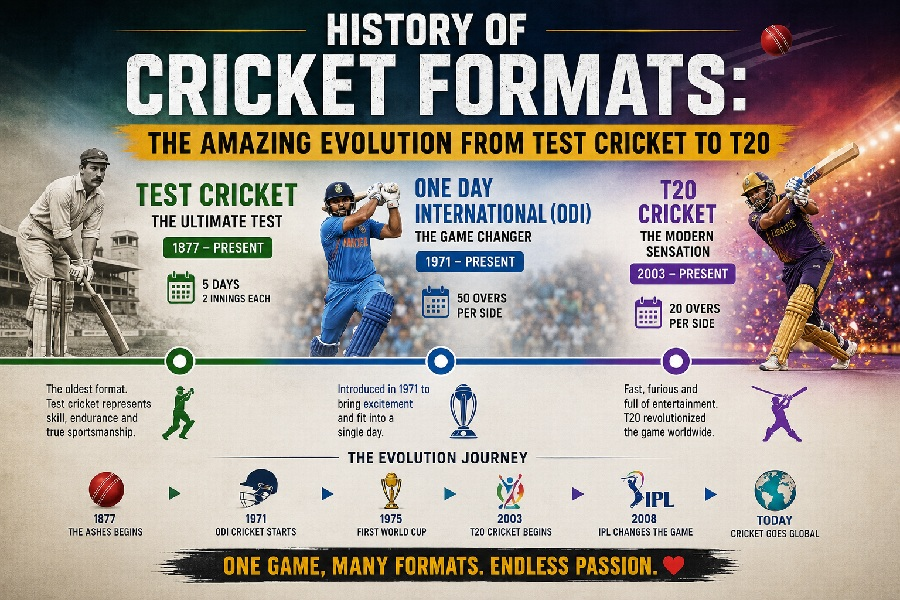

History of Cricket Formats
Cricket is one of the most popular sports in the world, but the game has changed dramatically over the years. From traditional Test matches lasting up to five days to fast-paced T20 games completed in just a few hours, cricket has continuously evolved to meet the changing interests of players and fans.
The history of cricket formats is a fascinating journey that shows how the sport moved from long-form matches to shorter, more exciting competitions. Today, Test cricket, One Day Internationals (ODIs), and Twenty20 (T20) are the three major international formats, each offering a completely different style of cricket.
What Are Cricket Formats?
Cricket formats are different versions of the game based mainly on the number of overs, match duration, and playing conditions.
The three major international formats are:
- Test Cricket – The longest and most traditional format
- One Day International (ODI) Cricket – A limited-overs format generally played over 50 overs per side
- T20 International (T20I) Cricket – A short format with 20 overs per side
Each format has its own strategy, skills, challenges, and fan base.
The Early History of Cricket
The origins of cricket can be traced back several centuries to England. Early versions of the game were much less organized than modern cricket.
During the 18th and 19th centuries, cricket became increasingly structured. Clubs, organized competitions, and standardized rules helped transform the sport into the game we recognize today.
As cricket spread beyond England, international competition gradually developed. The need for longer and more organized matches eventually led to the emergence of first-class and Test cricket.
Test Cricket: The Birth of International Cricket
Test cricket is considered the oldest and most traditional international format.
The first officially recognized Test match was played in 1877 between Australia and England in Melbourne. Australia won that historic match by 45 runs.
Test cricket introduced a form of the game where players had to demonstrate patience, concentration, technique, and physical endurance. Unlike limited-overs cricket, Test matches can last up to five days.
Key Features of Test Cricket
- Up to five days of play
- Two innings for each team
- No fixed number of overs for an innings
- Players need strong defensive and attacking skills
- Draws are possible
- Weather and pitch conditions can have a major impact
Test cricket remains the ultimate examination of a cricketer’s technique and temperament.
The Development of One Day Cricket
Although Test cricket remained hugely popular, its long duration created challenges for spectators and broadcasters. Cricket eventually began experimenting with shorter formats.
One-day cricket became increasingly popular during the 1960s and 1970s. The limited-overs concept offered fans the opportunity to watch an entire match in a single day.
The first men’s Cricket World Cup was held in 1975, featuring 60 overs per side. The West Indies won the inaugural tournament.
Over time, the standard ODI format developed into 50 overs per side.
Why ODI Cricket Became Popular
ODI cricket provided a balance between traditional cricket and fast-paced entertainment. A match could generally be completed within a day, while players still had enough time to build innings and develop strategies.
The format also introduced new tactical elements, including powerplays, fielding restrictions, aggressive batting, and specialized bowling plans.
The 1983 Cricket World Cup and ODI’s Global Growth
One of the biggest moments in ODI history came during the 1983 Cricket World Cup, when India defeated the West Indies in the final.
India’s unexpected victory dramatically increased cricket’s popularity across the Indian subcontinent. The tournament demonstrated how powerful limited-overs cricket could be as an international sporting spectacle.
The ODI World Cup subsequently became one of cricket’s most important global events.
The Rise of T20 Cricket
The next major revolution came with the introduction of Twenty20 cricket.
T20 cricket was designed to make the game shorter, faster, and more entertaining. Each team receives only 20 overs, meaning an international match can usually be completed in approximately three hours.
The first official men’s T20 International was played in 2005 between Australia and New Zealand.
T20 quickly attracted audiences because it combined aggressive batting, innovative bowling, athletic fielding, music, entertainment, and a short match duration.
The 2007 T20 World Cup Changed Everything
The inaugural ICC Men’s T20 World Cup was held in 2007 in South Africa.
India won the tournament by defeating Pakistan in the final. The success of the competition helped establish T20 cricket as a major international format.
The tournament also demonstrated the commercial potential of short-format cricket.
The IPL and the Global T20 Revolution
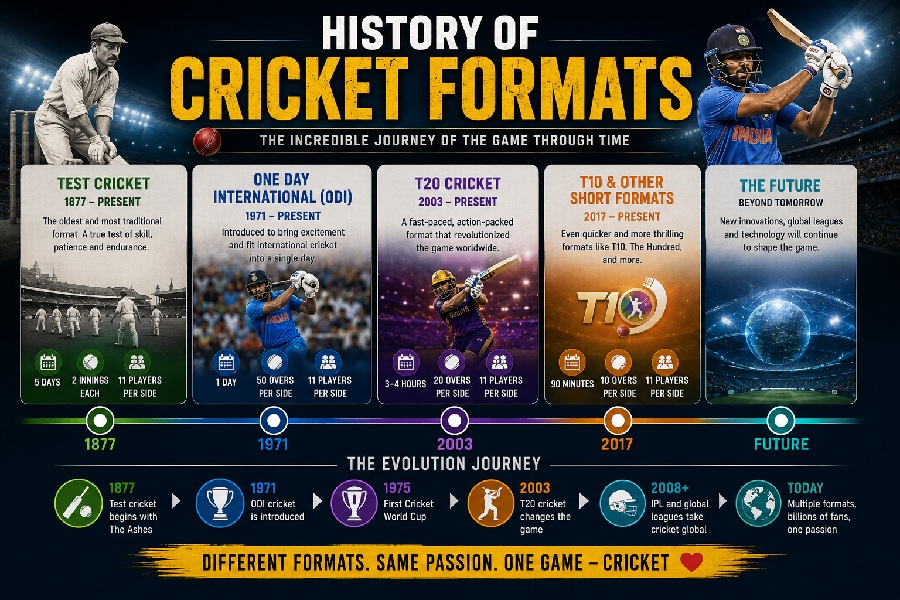
The creation of the Indian Premier League (IPL) in 2008 transformed T20 cricket.
The IPL introduced a franchise-based model that combined international stars, young players, entertainment, and major commercial investment.
Its success inspired the development of numerous T20 leagues around the world, including competitions in Australia, England, Pakistan, the Caribbean, South Africa, and other cricket-playing nations.
T20 leagues also created new opportunities for players to specialize in specific skills, such as power hitting, death bowling, spin bowling, and athletic fielding.
Test vs ODI vs T20
The three formats require different approaches from players.
| Feature | Test Cricket | ODI Cricket | T20 Cricket |
|---|---|---|---|
| Overs per side | No fixed limit | 50 | 20 |
| Duration | Up to 5 days | Usually one day | Around 3 hours |
| Innings | 2 per team | 1 per team | 1 per team |
| Main skills | Patience and technique | Balance and adaptability | Power and speed |
| Draw possible | Yes | No | No |
| Style | Traditional | Balanced | Highly aggressive |
How Batting Has Changed
The evolution of cricket formats has significantly changed batting.
Test cricket rewards players who can bat for long periods and build partnerships. ODI cricket requires a balance between strike rotation and boundary scoring. T20 cricket places enormous importance on scoring quickly.
Modern T20 batsmen have developed innovative shots such as ramps, scoops, switch hits, and reverse sweeps. These techniques have also influenced batting in ODI and Test cricket.
How Bowling Has Evolved
Bowling has also changed significantly.
Test bowlers traditionally focus on building pressure over long spells. ODI bowlers must manage limited overs while controlling scoring. T20 bowlers often have only four overs, making every delivery extremely important.
Modern bowlers have developed variations such as slower balls, yorkers, cutters, wide yorkers, and different types of spin to deal with aggressive batsmen.
The Role of Technology in Modern Cricket
Technology has played an important role in the evolution of cricket.
Modern cricket uses technologies such as:
- Decision Review System (DRS)
- Hawk-Eye
- Ball-tracking technology
- UltraEdge
- Spider cameras
- Advanced performance analytics
These technologies have improved decision-making and allowed teams to analyze players and opponents in greater detail.
Women’s Cricket and Format Expansion
The evolution of cricket formats has also been significant in women’s cricket.
Women’s Test cricket has a long history, while ODI and T20 cricket have provided additional opportunities for international competition. The popularity of women’s T20 leagues has helped attract new audiences and create professional opportunities for female cricketers.
The continued growth of women’s cricket shows that format innovation can contribute to the development of the sport worldwide.
The Future of Cricket Formats
Cricket is likely to continue evolving.
T20 cricket has become extremely popular, while Test cricket remains important for traditionalists and players who want to compete at the highest level of the sport. ODI cricket continues to play a major role, particularly through the Cricket World Cup.
New variations and shorter competitions may emerge in the future as cricket organizers look for ways to attract younger audiences and reach new markets.
However, the three major formats are likely to remain an important part of international cricket because each offers something different.
Conclusion
The history of cricket formats is a story of constant innovation. Test cricket established the foundations of international cricket, ODI cricket made the sport faster and more accessible, and T20 cricket introduced an entirely new era of short-format entertainment.
Each format has contributed to cricket’s global growth in its own way. Test cricket represents patience and tradition, ODI cricket provides balance and strategy, while T20 cricket delivers speed and excitement.
From the first Test match in 1877 to the global popularity of T20 leagues, cricket has continually adapted without losing its identity. This remarkable evolution is one of the main reasons cricket remains one of the world’s most fascinating and widely followed sports.