

Rahul Dravid and the Original Number of Balls in a Test Over
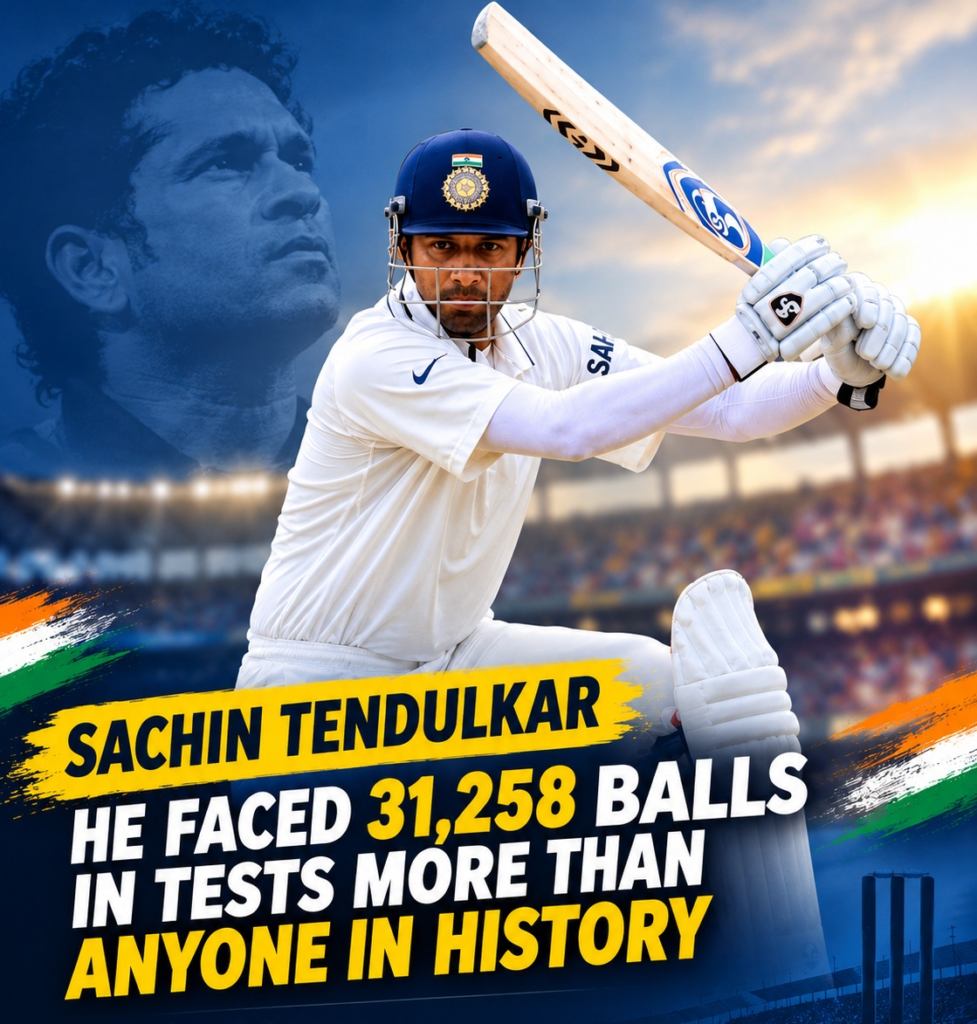
Rahul Dravid is one of the greatest Test cricketers in history, famous for his patience, technique and remarkable ability to occupy the crease for long periods. Known as “The Wall,” Dravid faced an extraordinary 31,258 deliveries in Test cricket, one of the strongest statistical reminders of his incredible endurance as a batter.
But a fascinating question often comes up among cricket fans: How many balls were originally there in one Test over?
The answer is surprising because the modern six-ball over was not always the standard in Test cricket.
How Many Balls Were Originally in a Test Over?
When Test cricket began, an over did not have a universally fixed number of six balls.
The earliest Test matches used four-ball overs. The number of deliveries in an over later changed in different countries and at different times.
Historical records show that four-ball, five-ball, six-ball and eight-ball overs were all used during different periods of cricket history. Since the 1979/80 season, however, Test cricket has used six legal balls per over.
So, if the question is:
“How many balls were originally in a Test over?”
The simple answer is:
Four balls per over.
However, the history is more complicated because the number changed several times before six became the universal standard.
Why Did the Number of Balls Change?
Early cricket did not have the highly standardized playing conditions that exist today. Different cricket-playing countries used different numbers of deliveries in an over.
For example, England used four-ball overs from 1880 to 1888, five-ball overs from 1889 to 1899 and six-ball overs from 1900 to 1938. During 1939–1945, England used eight-ball overs before returning to six balls from 1946.
Australia followed a different pattern. It used four-ball overs during the early period, later switched to six, then experimented with eight-ball overs during several periods, including from 1936/37 through 1978/79.
This shows why the history of cricket overs is much more interesting than simply saying that every over has always contained six balls.
When Did Six-Ball Overs Become Standard?
The six-ball over became the permanent standard for Test cricket from 1979/80.
Before the 1980 Code of the Laws of Cricket, the rules did not simply state that every over had to contain six balls. Instead, the number of balls could be determined by the playing conditions of the match.
The 1980 Code formally specified that the ball should be bowled from each end alternately in overs of six balls.
Today, a normal Test over consists of six legal deliveries.
What Does Rahul Dravid Have to Do With This?
Rahul Dravid played his entire international career in the modern era, when six-ball overs were the established standard in Test cricket.
Dravid made his Test debut in 1996 and eventually played 164 Tests, scoring 13,288 runs.
His career is particularly relevant to this topic because of the enormous number of deliveries he faced.
Dravid faced approximately 31,258 balls during his Test career, demonstrating just how much time he spent batting in the longest format.
Using six legal balls as the basis, 31,258 deliveries are equivalent to roughly 5,210 overs of batting.
That is an extraordinary number and perfectly reflects why Dravid earned his famous nickname, “The Wall.”
Rahul Dravid’s Incredible Patience
Dravid’s batting style was built around concentration, discipline and technique rather than simply scoring quickly.
One famous example came during India’s Test against Australia at the Sydney Cricket Ground in 2008. Dravid was on 18 when he played 40 consecutive deliveries without scoring a run. When he finally took a single, the crowd gave him a standing ovation.
That moment perfectly captured the qualities associated with Dravid’s Test batting.
He was prepared to leave the ball, defend for long periods and wait patiently for scoring opportunities.
Four-Ball vs Six-Ball Overs
The difference between four-ball and six-ball overs may look small, but it could significantly affect the structure of a cricket match.
| Over Type | Balls per Over |
|---|---|
| Early Test cricket | 4 |
| Some historical periods | 5 |
| Modern standard | 6 |
| Some historical periods | 8 |
Because the number of balls changed, the number of overs required to deliver a certain number of balls also changed.
For example, 24 deliveries would equal:
- 6 overs of four balls
- 4 overs of six balls
- 3 overs of eight balls
Therefore, comparing bowling figures across different historical eras requires an understanding of the number of deliveries in each over.
Did India Ever Use Eight-Ball Test Overs?
India’s Test matches have been played with six-ball overs, unlike some countries that experimented with eight-ball overs. Historical records show that India, the West Indies, Sri Lanka, Zimbabwe and several other Test-playing nations have used six-ball overs throughout their Test history.
This means that Rahul Dravid’s Test career was played under the familiar six-ball-over system.
Why Is Rahul Dravid Associated With Long Test Innings?
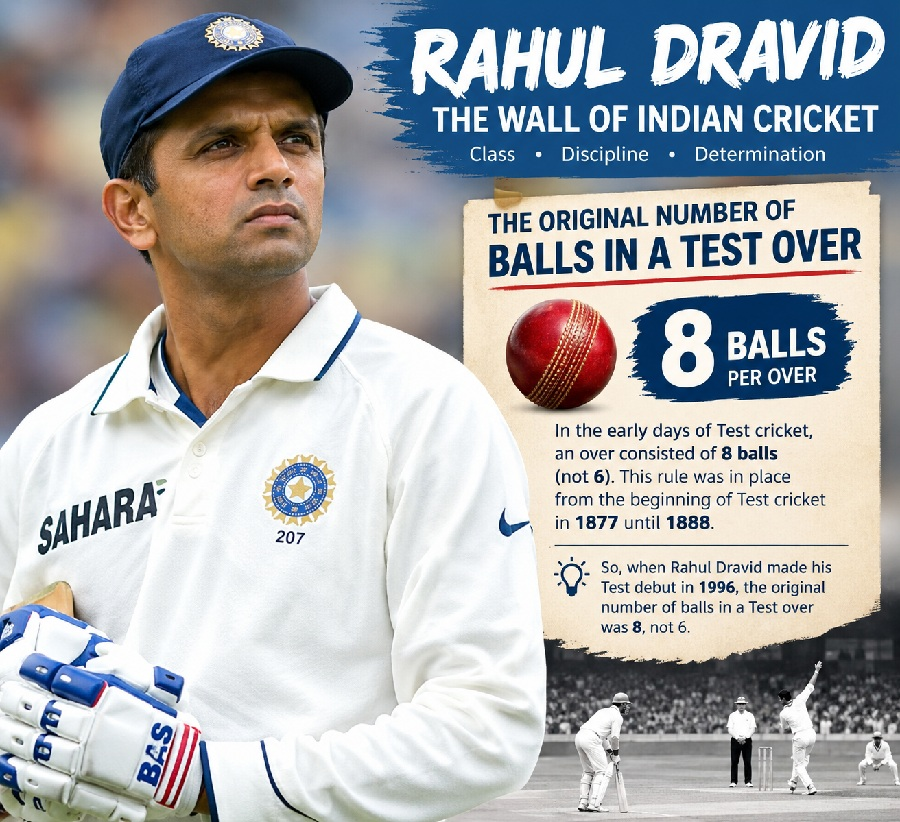
Dravid’s reputation came from his ability to bat for long periods against high-quality bowling attacks.
His career statistics demonstrate his extraordinary consistency. He scored more than 13,000 Test runs and played 164 Tests.
His defensive technique allowed him to survive difficult spells, particularly against fast bowlers and high-quality spin.
Rather than rushing to score, Dravid often concentrated on building an innings session by session.
That approach made him one of the defining Test batters of his generation.
Dravid and the Art of Playing Every Ball
The phrase “play the ball, not the bowler” is often associated with classical Test batting, and Dravid was an excellent example of this philosophy.
His ability to concentrate for hours meant that he could face hundreds of deliveries in a single innings.
One of his famous Test performances came against Australia in Adelaide in 2003, where he scored 233 runs in India’s memorable victory. More recently, reports have highlighted how Dravid’s partnership with VVS Laxman helped India recover from a difficult position in that match.
His long innings demonstrated the value of patience in Test cricket.
Final Answer: How Many Balls Were Originally in a Test Over?
The original Test over contained four balls.
However, cricket’s over system changed considerably over time. Different countries used four-, five-, six- and eight-ball overs during different periods. Eventually, six-ball overs became the universal standard for Test cricket from the 1979/80 season, with the 1980 Code formalizing the six-ball over.
Rahul Dravid did not play during the era of four- or eight-ball Test overs. His entire Test career took place during the modern six-ball era.
Nevertheless, his remarkable record of 31,258 Test deliveries faced makes him an especially interesting player when discussing the history and evolution of Test cricket.
Frequently Asked Questions
How many balls were originally in a Test over?
Originally, Test cricket used four-ball overs.
How many balls are in a Test over today?
A standard Test over contains six legal balls.
When did six-ball overs become standard in Test cricket?
Six-ball overs became the standard across Test cricket from the 1979/80 season.
How many balls did Rahul Dravid face in Test cricket?
Rahul Dravid faced approximately 31,258 deliveries during his Test career.
Why was Rahul Dravid called The Wall?
He earned the nickname because of his exceptional defensive technique, concentration and ability to bat for long periods.
Did Rahul Dravid play eight-ball Test overs?
No. Dravid’s Test career took place in the modern era of six-ball overs.