
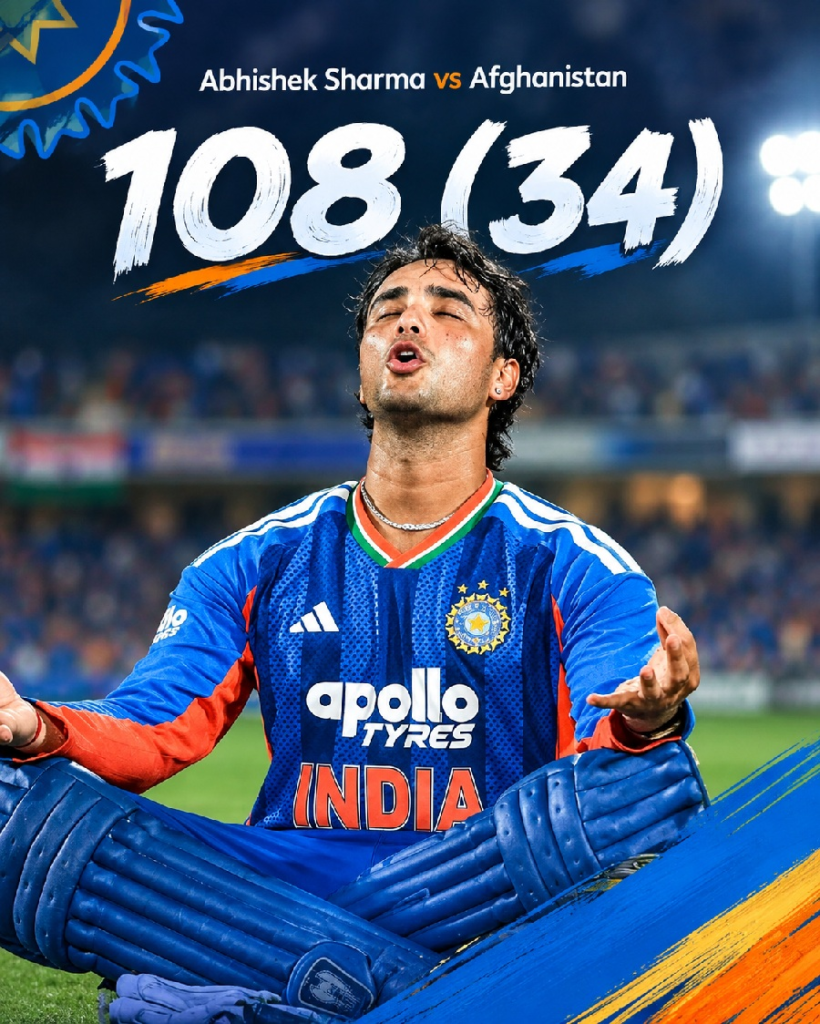

Abhishek Sharma smashed a record-breaking 30-ball century
Abhishek Sharma produced one of the most explosive batting performances of his international career against Afghanistan, smashing a breathtaking century off just 30 balls in the third and final T20I at the Arun Jaitley Stadium in New Delhi on September 17, 2026.
The left-handed Indian opener finished with 108 runs from only 34 balls, including 9 fours and 11 sixes. His extraordinary strike rate was 317.64, and his assault helped India post 221/7 before Afghanistan were bowled out for 94. India won the match by 127 runs and completed a 3-0 series sweep.
The biggest headline, however, was his 30-ball T20I century. It became the fastest T20I century by an Indian batter and the fastest century in a T20I between Full Member nations. ICC reported that the hundred was also the third-fastest century overall in men’s T20 internationals.
Abhishek Sharma’s 30-Ball Century Against Afghanistan
Abhishek walked out to open the innings with Sanju Samson after India were asked to bat first. Rather than taking time to settle, the young left-hander immediately attacked Afghanistan’s bowlers.
The first over from Fazalhaq Farooqi contained some controlled batting, but the restraint disappeared almost immediately.
In the second over, Abhishek attacked Azmatullah Omarzai, using powerful strokes through the leg side and over the infield. Farooqi was then attacked again, with Abhishek finding boundaries with remarkable regularity.
The result was an extraordinary powerplay.
Abhishek reached 50 runs from only 16 balls, putting himself within sight of a potentially historic century before the innings had even reached its halfway point. ICC noted that his 16-ball fifty was the joint-fourth-fastest fifty for India in men’s T20Is.
He continued attacking after the powerplay and reached 100 from 30 balls.
That moment immediately entered Indian cricket history.
Abhishek Sharma 108 Runs in 34 Balls
Although the century came from 30 deliveries, Abhishek did not stop attacking after reaching three figures.
He eventually fell for 108 from 34 balls.
His innings contained:
- 108 runs
- 34 balls
- 9 fours
- 11 sixes
- 30-ball century
- 16-ball fifty
- 317.64 strike rate
According to ICC, Abhishek’s 11 sixes were the second-most by an Indian men’s batter in a T20I innings.
The innings was brought to an end by Rashid Khan, with Abhishek dismissed just before the halfway stage of India’s innings.
Despite losing their explosive opener, India had already gained enormous momentum.
How Abhishek Sharma Reached His 30-Ball Century
Abhishek’s century was built around aggressive stroke-making rather than simply waiting for loose deliveries.
He attacked both pace and spin and repeatedly used his ability to clear the boundary.
His approach included:
- Powerful pulls
- Lofted drives
- Straight hitting
- Sweeps and slog-sweeps
- Aggressive footwork against spin
- Clean hitting over the leg side
- Lofted shots through the off side
The most remarkable statistic was that 96 of his first 100 runs came through boundaries, according to BBC’s match report.
That statistic illustrates just how aggressive the innings was.
Record Broken by Abhishek Sharma
Abhishek’s century broke an important Indian T20I record previously held by Rohit Sharma.
Before this match, Rohit held the record for the fastest T20I century by an Indian, having reached three figures from 35 balls against Sri Lanka.
Abhishek completed his century in 30 balls, improving the Indian record by five deliveries.
Fastest T20I Century by an Indian
| Batter | Balls | Opponent |
|---|---|---|
| Abhishek Sharma | 30 | Afghanistan |
| Rohit Sharma | 35 | Sri Lanka |
Abhishek’s achievement was not only an Indian record. ICC confirmed that it was the fastest T20I century in a match between Full Member nations.
Third-Fastest T20I Century Overall
The 30-ball hundred also placed Abhishek among the fastest century-makers in men’s T20I history.
ICC reported that his century was the third-fastest overall in T20Is.
That places the innings in a very small group of extraordinary international T20 performances.
The achievement is particularly notable because T20I cricket involves international bowlers, different playing conditions and enormous pressure compared with many domestic T20 competitions.
Abhishek Sharma’s Powerplay Record
The century was only one part of Abhishek’s record-breaking performance.
He also produced an extraordinary score during the first six overs.
India raced past the 100-run mark during the powerplay, with Abhishek contributing a record-setting individual score in the opening six overs.
Reports put his powerplay contribution at 76 runs, making it the highest individual score in the powerplay in men’s T20I cricket.
This was an important reason India were able to build such a huge total despite losing momentum after Abhishek’s dismissal.
Abhishek Sharma and Sanju Samson’s 142-Run Partnership
Abhishek was not alone in India’s explosive start.
He formed a remarkable opening partnership with Sanju Samson.
The pair added 142 runs for the opening wicket, giving India a huge platform during the first half of the innings.
Sanju Samson also contributed a valuable 50 from 35 balls.
The opening partnership meant India reached a dominant position before Afghanistan could make any meaningful impact with the ball.
India Reached 221/7
Abhishek’s departure at 108 came when India were already in a commanding position.
India eventually finished on 221/7 from 20 overs.
The score was enough to put enormous pressure on Afghanistan.
Although Afghanistan’s bowlers managed to slow India’s scoring after Abhishek’s dismissal, the damage had already been done during the opening overs.
India’s final total became the foundation for a comprehensive victory.
Afghanistan Were Bowled Out for 94
Afghanistan’s chase never developed.
They were eventually dismissed for 94 in 14.1 overs, giving India a 127-run victory.
India’s bowling attack maintained pressure throughout the innings.
Ravi Bishnoi took 3 wickets, while Nitish Kumar Reddy also claimed 3 wickets. Axar Patel took 2 wickets, with Jasprit Bumrah and Yash Thakur taking one each.
The result completed India’s 3-0 series victory.
Abhishek Sharma’s Celebration After the Century

After reaching his century, Abhishek produced a memorable celebration.
Instead of running around or performing a traditional celebration, he sat down on the pitch in a meditative pose.
The celebration quickly attracted attention because of its calmness immediately after one of the most explosive innings of his career.
Abhishek later explained that he had been practicing meditation for several months and wanted to express that side of himself after reaching the milestone.
The contrast was striking: moments earlier, he had been attacking Afghanistan’s bowlers with extraordinary aggression, but after reaching 100, he celebrated quietly.
Yuvraj Singh’s Advice to Abhishek Sharma
After the match, Abhishek revealed that Yuvraj Singh had played a role in his preparation.
According to India Today, Yuvraj advised him not to try to force every delivery after the second T20I. Abhishek then produced the record-breaking performance in the series finale.
The advice was particularly relevant because explosive players can sometimes become overly aggressive while attempting to maintain a high scoring rate.
Against Afghanistan, Abhishek combined aggression with enough shot selection to turn his attacking approach into a historic innings.
Abhishek Sharma’s Performance Across the Series
The 30-ball century was not an isolated performance.
Abhishek was productive throughout the three-match series.
His scores were:
- 82 from 32 balls in the first T20I
- 39 from 19 balls in the second T20I
- 108 from 34 balls in the third T20I
He finished the series with 229 runs, making him the leading run-scorer and earning the Player of the Series award.
The first match had already demonstrated his ability to dominate Afghanistan’s bowling attack. In that game, India chased down Afghanistan’s target with 38 balls remaining, with Abhishek scoring 82 from 32 deliveries.
His third-match century therefore capped an already strong series.
Why the 30-Ball Century Was Special
There are several reasons why Abhishek’s performance stands out.
1. It Broke an Indian Record
Abhishek became the fastest Indian to score a T20I century, breaking Rohit Sharma’s previous 35-ball record.
2. It Was a Full-Member Record
The century was the fastest T20I hundred between Full Member nations.
3. He Scored 108 in Only 34 Balls
The century itself was extraordinary, but Abhishek continued attacking and finished with 108 off 34.
4. He Hit 11 Sixes
His 11 sixes were among the highest recorded by an Indian men’s batter in a T20I innings.
5. He Dominated the Powerplay
His 76-run powerplay score established another major T20I benchmark.
Abhishek Sharma’s Batting Approach
One of the defining features of Abhishek’s batting is his willingness to attack from the beginning.
Traditional T20 innings can involve an opening batter spending a few balls assessing the conditions. Abhishek’s approach is different.
He looks to put pressure on bowlers early.
Against Afghanistan, that strategy worked almost perfectly.
His ability to attack both pace and spin meant Afghanistan could not easily settle into a defensive bowling plan.
Once he found his timing, the boundaries came at remarkable intervals.
The Importance of the Partnership With Sanju Samson
It would be easy to focus entirely on Abhishek’s century, but Sanju Samson’s contribution was also important.
Samson scored 50 from 35 balls, giving Abhishek enough support to attack aggressively.
Their 142-run opening partnership meant India had a strong foundation before the middle order came in.
The partnership also prevented Afghanistan from putting sustained pressure on India’s batting lineup.
Abhishek Sharma’s Road to the Record
The record-breaking century came after a period in which Abhishek had faced questions about his consistency.
Indian Express noted that he had enjoyed a major run during the 2025 Asia Cup, where he scored 315 runs and was named Player of the Tournament, before experiencing a less productive period around the T20 World Cup and subsequent matches.
His first two matches against Afghanistan offered signs of a return to form.
The third match then produced an emphatic response.
The progression from 82 to 39 to 108 showed how quickly his confidence and scoring momentum developed during the series.
Abhishek Sharma’s Records Against Afghanistan
Here are some of the major records associated with his innings:
| Record | Achievement |
|---|---|
| Fastest Indian T20I century | 30 balls |
| Fastest T20I century between Full Members | 30 balls |
| Overall T20I century ranking | Third-fastest |
| Powerplay score | 76 runs |
| Final score | 108 off 34 balls |
| Sixes | 11 |
| Fours | 9 |
| Strike rate | 317.64 |
| Opening partnership | 142 runs with Sanju Samson |
These statistics show that the performance was not simply a century but a multi-record innings.
India vs Afghanistan Third T20I: Match Summary
India: 221/7 in 20 overs
- Abhishek Sharma – 108 (34)
- Sanju Samson – 50 (35)
Afghanistan: 94 all out in 14.1 overs
- Ravi Bishnoi – 3 wickets
- Nitish Kumar Reddy – 3 wickets
- Axar Patel – 2 wickets
- Jasprit Bumrah – 1 wicket
- Yash Thakur – 1 wicket
Result: India won by 127 runs.
Series result: India won 3-0.
What the Innings Means for Abhishek Sharma
The performance adds another major chapter to Abhishek Sharma’s international career.
He had already established himself as an aggressive left-handed opener, but a 30-ball international century gives his career a particularly significant statistical landmark.
It also demonstrated his ability to turn a strong start into an extraordinary individual score.
The performance against Afghanistan showed three important elements of his batting:
Power: He cleared the boundary 20 times.
Speed: He reached 100 in only 30 balls.
Consistency: He had already scored 82 and 39 in the first two matches of the series.
Together, those performances made him the central batting figure of India’s 3-0 series sweep.
Frequently Asked Questions
How many balls did Abhishek Sharma take to score his century?
Abhishek Sharma scored his century from 30 balls against Afghanistan in the third T20I on September 17, 2026.
How many runs did Abhishek Sharma score?
He scored 108 runs from 34 balls, with 9 fours and 11 sixes.
Whose record did Abhishek Sharma break?
He broke Rohit Sharma’s record for the fastest T20I century by an Indian, improving the mark from 35 balls to 30.
Was Abhishek Sharma’s century the fastest in T20I cricket?
It was the fastest T20I century between Full Member nations and the third-fastest overall men’s T20I century, according to the ICC.
How many sixes did Abhishek Sharma hit?
He hit 11 sixes in his 108-run innings.
Who dismissed Abhishek Sharma?
Rashid Khan dismissed Abhishek Sharma for 108.
How did India perform against Afghanistan?
India scored 221/7 and then bowled Afghanistan out for 94, winning by 127 runs. India consequently completed a 3-0 series sweep.
Conclusion
Abhishek Sharma’s 30-ball century against Afghanistan was a landmark performance in Indian T20I cricket.
The left-handed opener scored 108 from 34 balls, including 9 fours and 11 sixes, after reaching his century in just 30 deliveries. The innings broke Rohit Sharma’s previous Indian record and became the fastest T20I century between Full Member nations.
His extraordinary start also helped India post 221/7, while his opening partnership with Sanju Samson reached 142 runs. Afghanistan could manage only 94, resulting in a 127-run Indian victory and a 3-0 series sweep.
For Abhishek Sharma, the match represented much more than a personal milestone. After scoring 82 and 39 in the first two matches, he produced the defining innings of the series in the final game.
The combination of 30-ball century, 108 runs, 11 sixes, a record powerplay score and a series-winning performance makes this one of the most memorable innings of his international career.